Disaster Response Drones: UAVs strengthening the Emergency Logistics
Disaster Response drones are offering new ways of catering to emergency situations, and they are changing how emergency teams respond to any roadblocks, cyclones, forest fires, and industrial accidents. In times of emergency, quick aid is very important; in such moments, drones create a fast aerial layer that supplies the necessary supplies and provides quick aid to the people. It helps the responders to act and deliver faster.
The importance of rapid response in the world of disaster management cannot be overemphasized. The delay of any one thing can have a cascading impact in any emergency. A blocked route may delay the transportation of an emergency medical service. The traditional emergency systems, such as ground teams, ambulances, and relief vehicles, will always be more efficient, but sometimes they are not enough to help these challenges quickly. Drones are fast, can be employed quickly, inspect damaged bases, and efficiently support emergency logistics.
The use of disaster response drones can help authorizations, defense teams, other companies, and emergency responders to reduce response times and enable effective coordination in high-pressure situations.
How do disaster response drones help in Emergency Logistics?
There are several ways that drones help in disaster response. Depending on the situation, payload, endurance, area of operation, and kind of emergency they are deployed for, their role differs.
Rapid Damage Assessment-
Drones fly over the affected area and help in providing a rapid damage assessment. It captures high-resolution videos and images and helps in identifying broken bridges, damaged roads, collapsed buildings, damaged powerlines, and unsafe working areas quickly.
Search and Rescue Support-
Conventionally, the inspection and the scanning of the larger areas were done manually, but with thermal cameras, high- tech resolution sensors, and drones are able to find trapped people in low-visibility areas. It helps the rescue team reduce danger, scan large areas, and supply effective assistance.
Quick Delivery of Essential Supplies-
If roads are blocked or insecure, UAVs can help provide emergency services. It can transport medicines, First aid kits, communication equipment, food, and batteries. Larger UAV platforms can support heavier emergency loads.
Infrastructure Inspection-
Drones help infrastructure teams investigate damage without sending people to hazardous areas. For example, after a cyclone or flood, drones can inspect transmission storms, damaged conductors, roads, and remote infrastructure. It accelerates the process and helps teams resolve what equipment is needed.
Disaster Response Drones: Key Features essential for emergency readiness
The calamity environments are unpredictable and often difficult; a drone used in these missions must be reliable, stable, and ready for operation.
- Ability to carry heavy payloads strongly and efficiently
- Long endurance
- Stability to fly during cold winds and in difficult conditions
- Reliable communication link
- Precision hover and controlled deployment
- Environment-friendly, using safe recovery systems
- Camera, thermal, and payload mapping compatibility
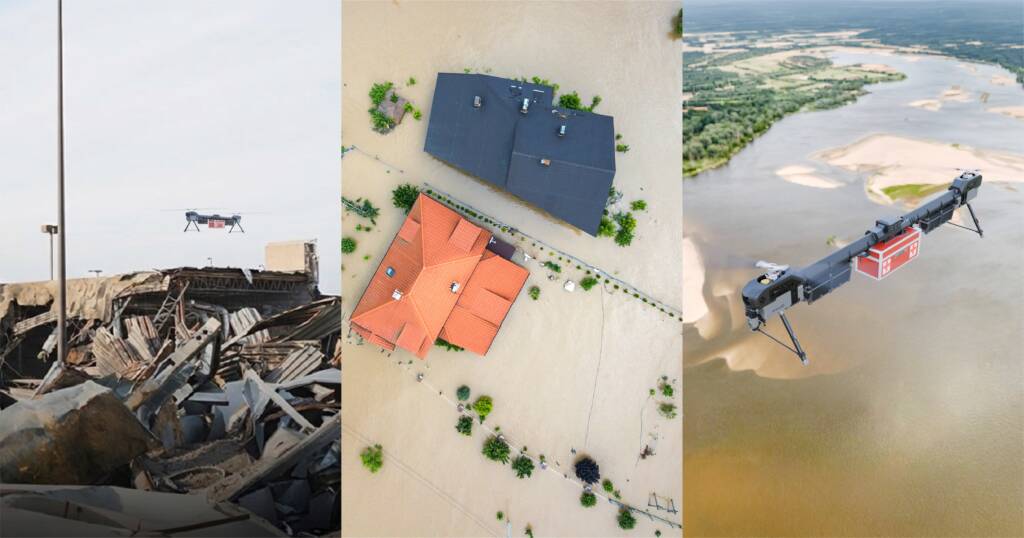
For small commissions, light drones are important for supporting mapping, monitoring, and small deliveries, and for large emergency logistics, UAVs can support carrying heavy payloads over longer distances.
That’s where the next phase in disaster response drones comes into picture. The Future will not only be about drone observation, but it will also be about drone observation, carriage, delivery, and support of complex field operations.
How Disaster Response Drones Will Shape Future Relief Operations
The Future of emergency logistics will be more interconnected, faster, and efficient. The drones will work in addition to satellites, command centers, ground teams, helicopters, ambulances, and digital mapping tools.
In upcoming years, drones will be more integrated into emergency logistics and will shape the relief operations by integrating the following:
- AI analysis of the affected area
- Automated mapping of the zones
- Multi-Drone coordination
- Enabling large payload support
- Long endurance
- Carrying out efficient dark operations
With the improvement of UAV technology, disaster response drones have become active logistics and intelligence platforms in emergency logistics.
For India, this Future is especially relevant. Climate consequences, infrastructure growth, development of remote areas, and high altitude operations all require faster and safer response systems. Drones can serve to bridge the gap between the communities required and the teams trying to reach them.
Disaster Response Drones: Building faster Relief systems for emergency logistics
When roads are completely destroyed, communication lines are out of action, and travel to affected communities can be uncertain in a matter of minutes. In such cases, speed and visibility are as vital as the relief material itself. A disaster response drone can make a significant impact in this stage by giving teams the capability of figuring out what is actually happening on the ground more quickly and responding in a more coordinated manner.
The value of drones lies in their ability to reach places where people and vehicles may not go immediately. They can assess damage, locate people, inspect damaged areas, and support the deliveries of supplies such as medicines, food, batteries, communications equipment, and emergency kits. They do not replace the manual supporters, but they make their work faster, safer, and more informed.
As disasters become more complex, disaster response drones play a more important role in emergency logistics, advancing our understanding significantly. They can link affected areas to dominant centers, ease teams, healthcare workers, and infrastructure repair teams, to support assistance operations, research operations, mapping, and disaster recovery.
The Future of disaster response will depend on how quickly teams can see, decide, and act. With the support of the right UAV platforms, trained operators, and integration into emergency systems, disaster response drones can help create a more resilient response framework.