


Drone-Powered Powerline Operations
Powerline Operations Enhanced by Aerial Robotics and Intelligent Software, Boosting Grid Capacity and Automating Line Construction
Automating Powerline Grid Operations:
We help power companies through our Drone-as-a-Service (DaaS) model; you get access to proven UAVs, smart software, and a team of experts who make execution simple and reliable. From mapping sites, planning corridors, and stringing cables to lifting materials and maintaining towers with inspections and insulator cleaning, we take care of the heavy lifting so your teams can focus on keeping the grid strong and communities connected.
Contractors/ EPCs
We enable EPC partners to be more efficient at execution. Our drones are force multipliers on the ground by:
Streamlining stringing operations: Lifting and guiding stringing cables safely across long and challenging spans, ensuring faster and risk-free delivery.
Lean & efficient execution: Eliminating the need for helicopters, scaffolds, and high-risk manual climbs.Owners & Developers
Our services help project owners deliver reliable electricity faster. By outsourcing to us, they gain:
Enhanced safety & compliance: Minimizing the risks to workers' lives in difficult terrains and ensuring quality standards.
Optimized cost efficiency: Reducing project delays by replacing the manpower with drones.

CONVENTIONAL APPROACHES ARE HOLDING BACK POWERLINE OPERATIONS
Shifting heavy trucks, scaffolds, or helicopters through forests, rivers, and mountains slows progress, while drones reach towers directly for mapping, stringing, and inspection without ground barriers.
Operators working at heights or in proximity to live lines are exposed to great risks. Drones perform inspections, insulator washing, and cable stringing work, avoiding personnel from entering hazardous areas.
Helicopter scheduling, manual surveys, and weather disruptions often extend timelines. Drones enable faster tower-to-tower operations, from pilot rope delivery to TNP lifting and line inspection, all in reduced time.
Using helicopters, fuel, scaffolding, and big crews push costs while drone operations can reduce lifting, monitoring, and inspections with smaller crews and reusable UAV systems.
Ground operations disrupt the terrain and involve time-consuming approvals. Drones conduct site surveys, line patrols, and tower inspections with little environmental disruption.
ENHANCING GRID RELIABILITY WITH DRONE-BASED SOLUTIONS
Our drones are engineered to handle demanding tasks and ensure faster connectivity,
reliable deliveries, safer inspections, and efficient supply drops.
WHAT SETS DRONE-BASED SOLUTIONS APART IN POWER LINE OPERATIONS?
Conventional Method
It is done by a human workforce using traditional survey instruments including total stations, theodolites, or GPS handhelds, often resulting in slow progress and increased worker fatigue.
Power cables are strung by a human workforce with the help of cranes, causing significant delays and exposing workers to height-related dangers.
Materials are transported using human labour, porters, ponies, trucks, cranes, or helicopters, leading to slower operations and high logistical expenses.
They are inspected by humans using binoculars or ground-based observation, which compromises inspection quality and puts workers near electrical hazards.
Cleaning is done by a human workforce using cranes and helicopters, resulting in high costs, slow execution, and elevated accident possibilities.
Drone-Based Solutions
Drone-based LiDAR and photogrammetry surveys are used for faster and more accurate mapping, improving productivity while reducing manual labor risks.
Lightweight drones are used to deploy pilot cables across towers efficiently, enabling quicker installation while lowering the risk of accidents.
Heavy-lift drones deliver materials directly to towers or remote locations, speeding up transportation and reducing manpower dependency in tough terrains.
Drones with high-resolution and thermal cameras autonomously scan power lines, increasing fault detection speed and keeping inspectors safe from risks.
Drones with water or dry spray systems clean insulators safely and efficiently, minimizing maintenance time and enhancing operational safety.
WHY SHOULD YOU CHOOSE ENDUREAIR?
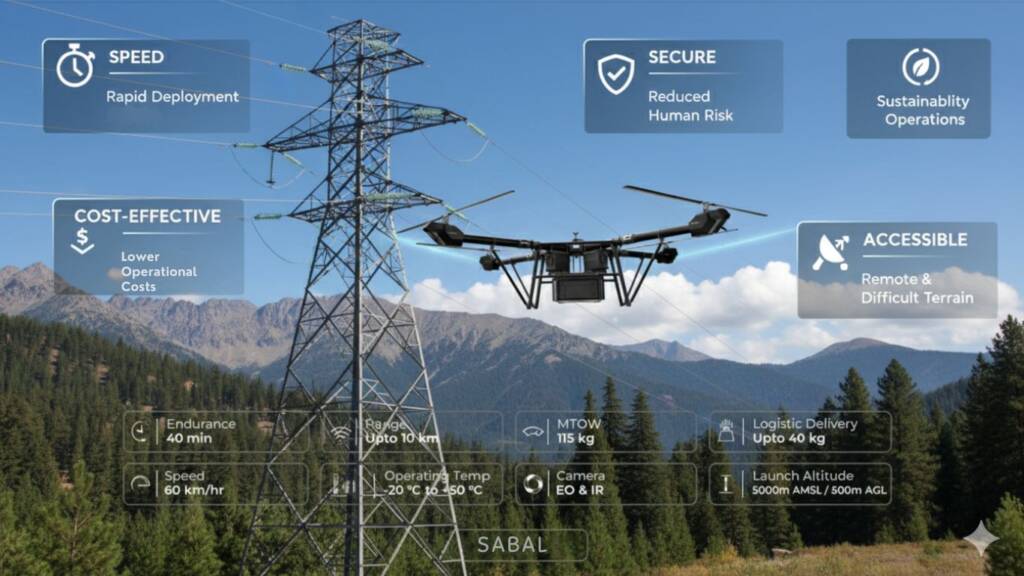
Speed & Reliability
Facilitate quick deployment and regular inspections, providing uninterrupted fault detection, minimizing downtime, and maximizing infrastructure uptime.
Stable & Secure
Minimizing human exposure to high altitudes, ensuring safe and steady inspections of powerline while eliminating manual risks.
Cost-Effective
Cuts down the need for cranes, porters, and helicopters in stringing and inspection tasks
Accessible & Scalable
Accessible in areas not otherwise accessible by road.
Supports Sustainability
Encouraging environmentally low-impact usage with little environmental disturbance.
FIND ANSWER TO
COMMON UAV QUERIES
Drones enable faster, safer, and more efficient power line mapping, stringing, inspection, and maintenance with minimal human involvement.
Yes, drones designed for critical operations, such as military and industrial use, are EM-shielded and tested for stable performance near high-voltage lines, minimizing interference risks.
Absolutely, drones can easily access locations that are difficult or impossible to reach by road, including mountainous and forested regions.
Drones can be used for mapping, pole stringing, power line inspection including thermal imaging, insulator cleaning, and emergency response support.
Drones reduce operational costs by minimizing manpower, equipment like cranes and helicopters, and downtime, leading to faster project completion.
