How advertising is going beyond static DOOH, from the streets to the skies
An Introduction to When the Streets Stop Turning Heads
Being there has always been a big part of outdoor advertising. Brands have always needed to be seen to stay relevant, from big billboards on highways to digital screens in malls and commercial districts. But being seen isn’t enough anymore.
People today walk through cities full of screens. Billboards that don’t move blend in with the background. People increasingly accept even digital DOOH, which used to be seen as disruptive. People browse faster, look away sooner, and instinctively ignore places that are easy to guess.
This increased tiredness is prompting marketers to ask a fundamental question: Where does attention really live today?
The answer is no longer just the streets below; it now includes the skies above.
The Change in Outdoor Advertising
Outdoor advertising has changed over time to keep up with how people travel, get to work, and watch TV. Old-fashioned billboards were made to be big and used again and again. A fixed message that was shown over time relied on regularity to help people remember it. It worked back when there weren’t as many things to look at.
The following change was digital DOOH. Screens moved. Messages turned. Content that changes based on the time of day and your location.
DOOH made things more flexible and easier to measure, helping marketers update their creative without changing their actual infrastructure. But this change also brought forth new problems. As more firms started using digital screens, the best spots filled up rapidly. What used to be eye-catching becomes part of the noise. The medium changed, yet the space got more packed.
It’s a paradox: more screens but less attention.
The Problems with Static DOOH
There is still a place for static, fixed-location DOOH, but its limits are becoming harder to ignore
The most evident problem is visibility overload. In places with a lot of people, there are sometimes dozens of conflicting signals that are close together. Even high-end positions struggle to stand out.
Being predictable makes things less impactful. People stop paying attention to commercials when they know where they will show up. The brain puts these messages in the background.
Another problem is passive consumption. Most static DOOH relies on people seeing it by chance rather than on purpose. People see the ad because it's there, not because it asks for their attention.
Last but not least, attention spans are getting shorter. People look, not stare. A static screen usually only gets a few seconds of half attention, which makes it hard to tell stories and remember things.
These aren’t problems that require creativity. They are structural.
The Growth of Aerial Advertising and Digital Billboards That Fly
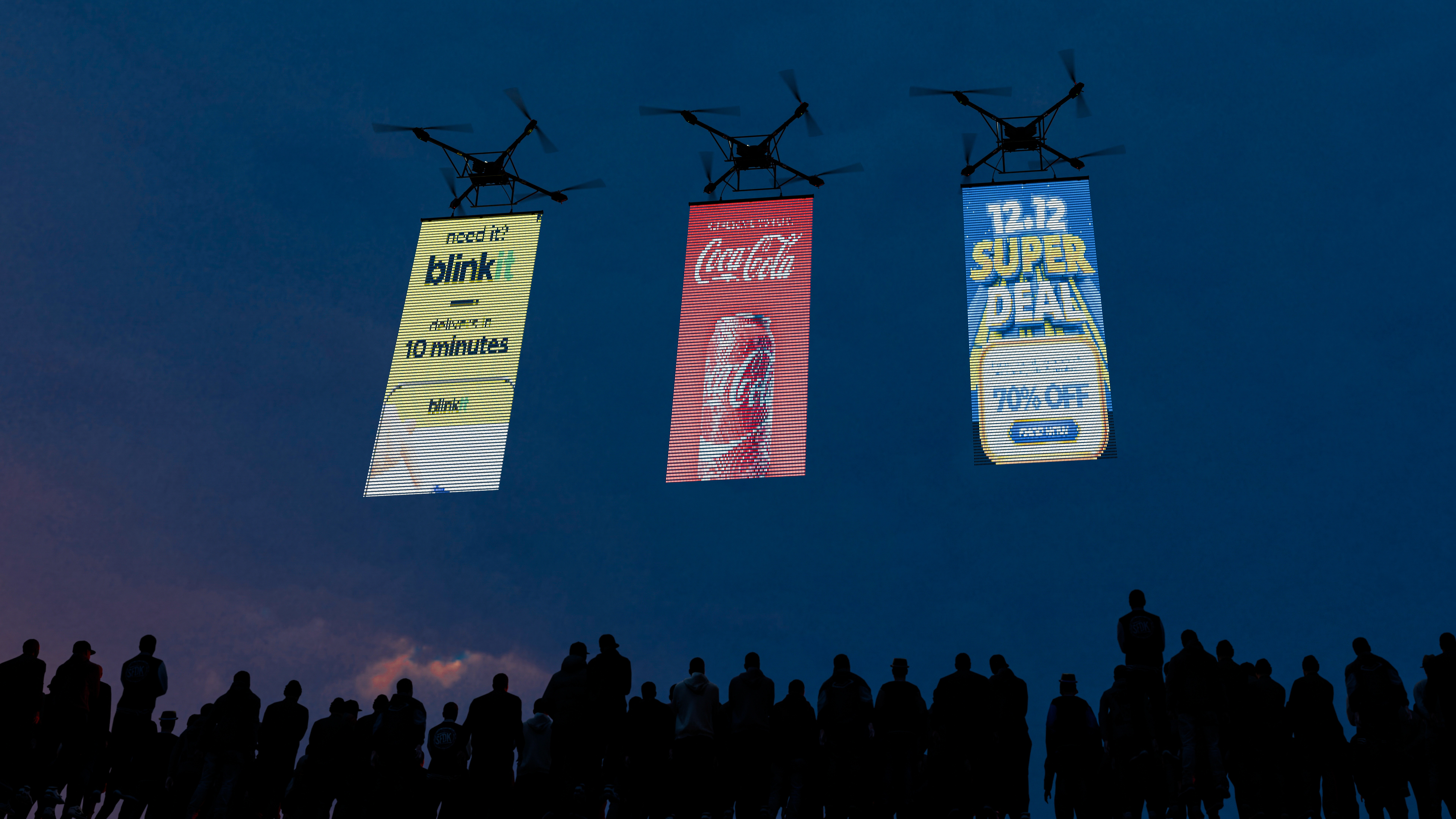
Aerial advertising changes more than simply what the message says; it also changes where it appears. The sky is mostly clear. When a moving digital display enters that space, it disrupts visual habits. People glance up not because they are told to, but because something strange is happening. Movement influences how people pay attention. People are programmed to see movement. A flying digital billboard uses this propensity to turn short bursts of interest into long-lasting attention.
New things make it easier to remember. Seeing a corporate message in the air feels more like an experience than an ad. People see it as an event, not a stock. This medium works best for event-driven placements. High-impact moments are better for product debuts, significant events, brand activations, festivals, and sports events than long-term exposure. Aerial advertising works well in these situations.
This is not about replacing DOOH, which is essential. It’s about making the canvas bigger.
The Effect of Marketing on Brand Value
Impressions alone don’t define success in modern marketing anymore. It is based on the quality of attention. Aerial advertising places greater value on getting the public’s attention than on repeating the same message. It prioritizes fewer but more meaningful interactions over numerous passive opinions.
It aligns with experience-based advertising, where the media itself is part of the story. People remember how they found the brand, not simply the message. There is also a significant effect of social amplification. People are more likely to take pictures of, share, and talk about Unexpected visual events online, which extends the event’s reach beyond its premises.
From a brand perspective, this means that people will remember the brand better, see it as more innovative, and perceive it as more distinct in crowded categories.
What to Expect in the Future: Ground Meets Sky
It’s not about choosing between static and aerial media for outdoor advertising in the future. It’s all about bringing things together.
Brands will likely use both ground-based DOOH and aerial placements to make their ads more consistent and more impactful. One makes things more familiar, while the other makes things more interesting.
As cities get more crowded and people get pickier, experiential forms will take over. Ads that blend in with the surroundings rather than being disruptive will get attention without asking for it.
The sky, which was formerly overlooked as a place to advertise, is now becoming an essential part of the media mix.
Rethinking Where Attention Is
Outdoor ads are still important. It’s changing.
As static formats become less popular, marketers are exploring new ways to reconnect with customers who are distracted. The shift from streets to skies reveals a broader truth in marketing today: people pay attention to new ideas.
People who recognize this change early on will not just be viewed more favourably; they will also be more likely to succeed. People will remember them for a long time.