Drones in Conductor Stringing : Revolutionizing Power Grid Operations
The modernization and expansion of Power grids all over the world are critical to support the growing electricity demands worldwide. At the core of this crucial and important process lies conductor stringing operations that involve installing electrical conductors across the towers to support and transmit electricity and enable efficient power supply.
Traditionally , this wire stringing operation was done by humans , and it was a labour intensive approach which involved excessive time utilization , requiring lots of manpower , heavy equipment and complex logistics . As technology upgrades and with the advent of urbanization , the more simpler and easier approach comes into the picture that is drones in conductor stringing . Today , they have emerged as one of the cost-effective and practical approaches used in various activities in powerline inspection and operation.
By integrating advanced UAV technology into transmission workflows , the industries mitigate their challenging tasks , which was conventionally very difficult to mitigate and solve. It provides an effective and better solution to the powerline industry.
Conductor Stringing : Importance and Why does it matter ?
Stringing a power line entails setting up the conductors (electrical cables) between transmission structures. This work comprises several phases, such as setting up the initial guide rope, applying proper tension, and finally putting the main conductors in place. The efficiency of the conductor stringing directly depends upon the various factors like:
- Project Timelines
- Human Labour Safety
- Complete Grid reliability
- Operational Costs
In large transmittance undertakings, even low inefficiencies in the cash flow management system can lead to delays and cost overruns, working smoothly within the established system.
Traditional Conductor Stringing Operations : Challenges and Risk Associated
As the power supply demands increase in the world , the traditional approach also fades out due to various risks and challenges associated with it . Despite of large transmission networks , conductor stringing methods continues to face several challenges , which are listed below:
Prone to High Risks :-
Manual operations require manforce to climb the high altitude towers and work in difficult terrains , which increases the risk of the accidents in the area.
Time - Intensive Approach
The conventional methods are very time consuming , as there were various activities like setting up equipment, mobilizing crews which takes weeks or months to get completed .
High Operational Cost:
The use of cranes , helicopters and other technologies increases the operational costs which increases the overall cost of the project.
Difficult Terrains:-
The traditional approach involves labours to work on the difficult terrains like rivers, forests, and high-altitude mountains, which directly increases the time to complete the work and becomes riskier for them.
These are the difficulties and challenges faced by the industries previously while operating the powerline project, but drones introduce a much cheaper and cost-effective approach to it.
Future of Power Grids: Drones Transforming the Conductor Stringing Methods
The integration of drones into transmission projects changes the chain of scale approach. The drone based framework lets you create monotone-based systems that offer a more nimble, efficient, and secure alternative to traditional methods. Some key features are mentioned below:
- Enhanced Safety
- Faster Deployment
- Accessibility to difficult terrains
- Precision in Pilot Rope Deployment
- Budget- friendly approach
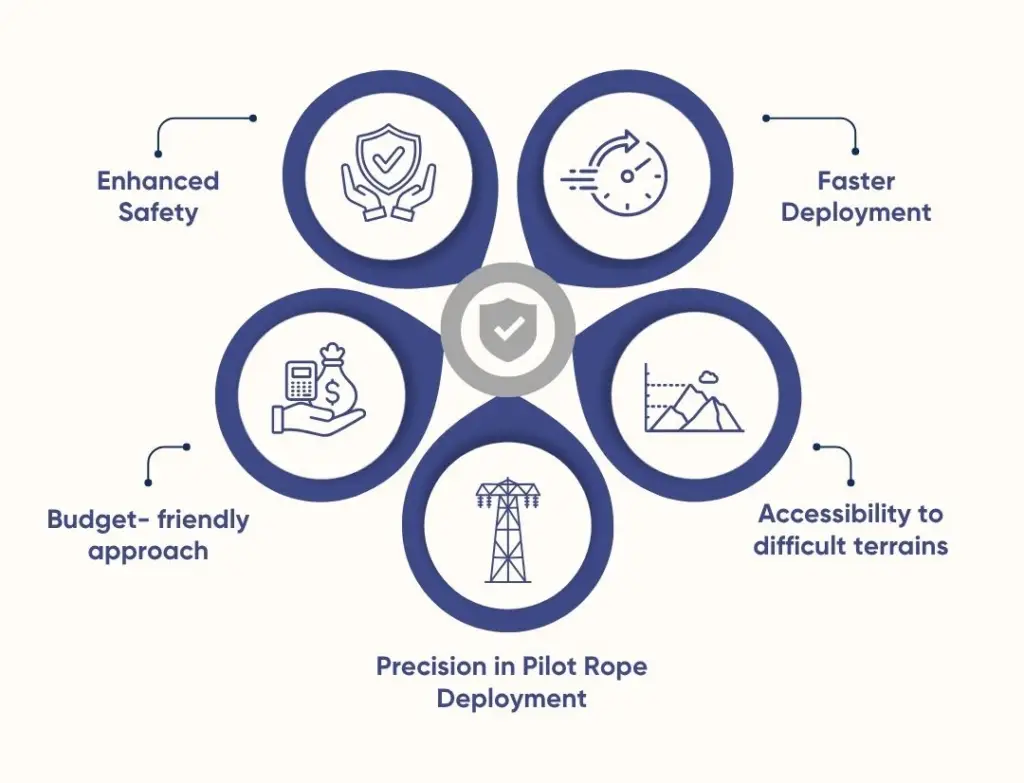
The approach is focused on the mechanical network base, to see drivers’ chains become faster, safer, and more effective.
Applications of Drone- Based Conductor Stringing
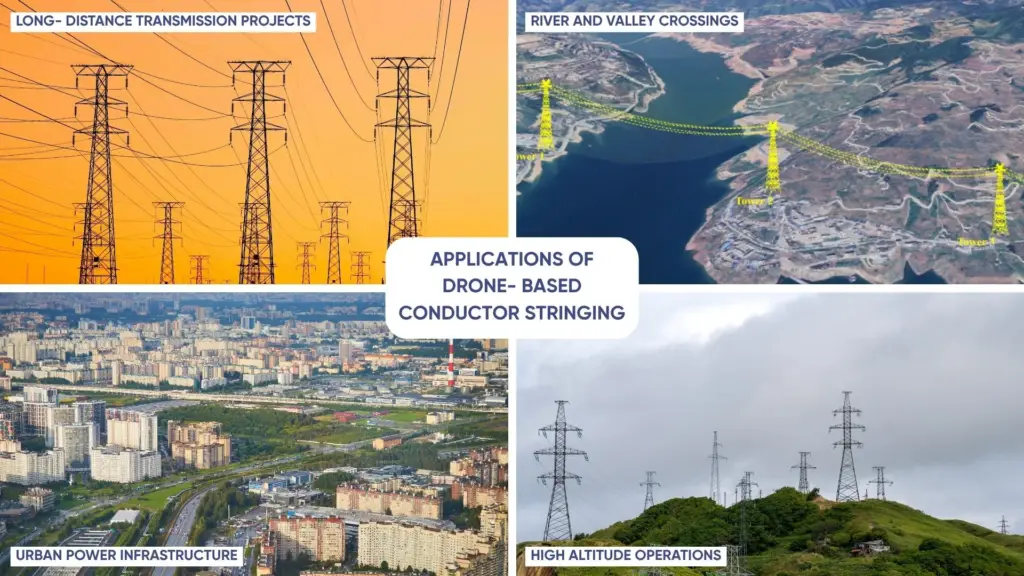
Drone enabled conductor stringing approach is widely accepted and used by several industries catering to their challenges and risks. It serves various applications and some of them are mentioned below:-
Long- Distance Transmission Projects :-
Drones help in conducting and accelerating the large and widely extended projects efficiently and effectively.
River and Valley Crossings :-
Deploying conductor stringing over natural obstacles is considerably simplified with drone assistance.
Urban Power Infrastructure :-
Drones enable the wire stringing in the difficult urban areas which are congested in nature with minimal disruptions .
High Altitude Operations :-
In high altitude and mountainous regions, generally difficult terrains, drones deploy faster and safer results. It eliminates the need for manual interventions.
What is the Next Phase in the Conductor Stringing Operations?
The electricity shipping sphere is still being modernized, and the introduction of automation and advanced technologies becomes more necessary than potential, bringing together solid research with practical value. One approach to the next phase of the driver training program is fuelled by the convergence of monotone technology with intelligent schemes such as artificial intelligence and real time analytics.
This evolution is expected to reshape how these operations are operated, maintained and executed and monitored . The process will become more data driven , automated and precise with the leading technology.
Few key trends :
Increase in adoption of autonomous drone based solutions
Real time monitoring through integrated technologies
Data driven decisions for enhanced efficiency
Integration with smart Grid digital infrastructure systems
Redefining Future Conductor Stringing Operations in Powerline Grids
The evolution of power transmission infrastructure requires a transition from conventional methods to smarter and more efficient solutions. Drone technology is no longer an additional instrument; it is becoming increasingly central, as cutting-edge transmission projects are being applied.
Where this succeeds is that by increasing speed, safety, and usability, the Chiefs’ drone chain helps public service, and EPIC companies overcome the challenges of topography, forces, and undertakings. The point is that what has previously required assets and length can be achieved with precision, acuity, and less danger.
Beyond the operational shifts, it also aligns with broader industry goals, which enhance the grid operations by accelerating the infrastructure and transmission projects, enabling the sustainable expansion of powerline networks. As the energy demands increase the need to scale these grid operations, which include various activities like conductor stringing, wire stringing, payload dropping, mapping, and surveying, requires a better and advanced approach to perform them; therefore, drones in powerline operations serve as a scalable and efficient technology-driven solution to them.
Automating Grid Power Operations: Upgrading to Smarter Power Sectors
Grid Operations are no longer just an execution function; they are a strategic enabler to upgrade the power infrastructure into a smarter, faster, and more efficient manner. The future of Powerline operations lies in the integration of automation and intelligent software.
They are strategic drivers of power infrastructure development. Their ability to surrender projects faster, maintain assets efficiently, and respond to real-time challenges straightaway affects the reliability and scalability of the energy power sector.
As the industry continues to evolve, organizations using this engineering will be better placed to produce sustainable and renewable electricity and future-ready power networks.