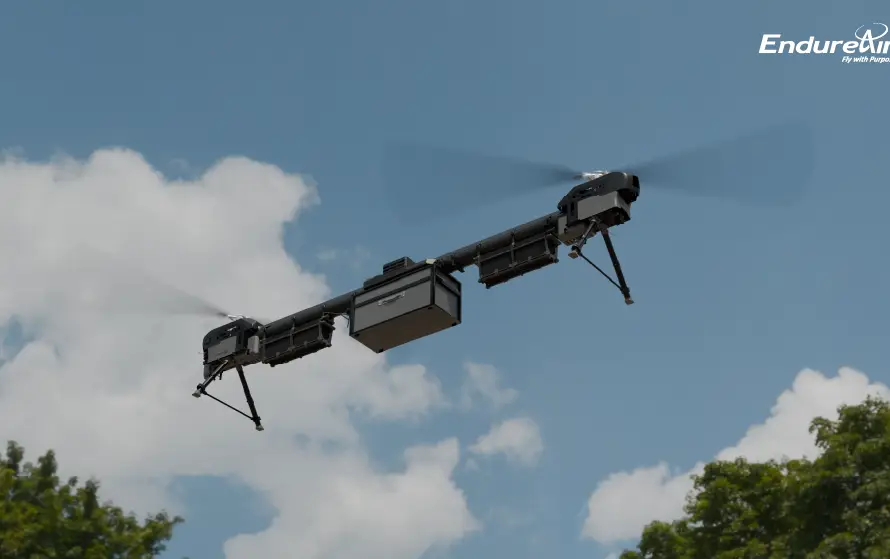
In the Grid power operations, as the growing urbanisation and advancing technology, the conventional methods, especially in transmission and line execution, are fading; as a result, the modern power systems are evolving all around the world to reduce the time and mitigate the risk, which are constrained by terrain, logistics, and infrastructure limitations. Transforming the power infrastructure through drone as a service is emerging as a practical and transformative approach.
Today, with expanding transmission networks and transmission and stringing operations in remote and terrain areas, the need for faster, safer, and more efficient powerline operations is required. Through the drone as a service model, the accessibility of proven UAVs and smart software has become readily available. From mapping sites, planning corridors, and stringing cables to lifting materials and maintaining towers with inspections and insulator cleaning, all becomes easy and simple with the help of drones.
The transmission Sector is expanding very rapidly and Fastly as it has played a very important role in meeting the rising demand of electricity all over the world. The need to modernise and automate the Grid Operations has become very crucial. As of recent reports in 2026, the total length of transmission lines at 220 kV and above reached approximately 501,766 circuit km. The sector is growing, with 114,687 km of new transmission lines planned between 2022-27. Therefore, the need to transform the Grid Power infrastructure is required.
The Need for Transforming the Grid Power Operations:
Traditional and Conventional Power Infrastructure Operations are failing now, the structure has lots of loopholes in multiple segments that has slow down the execution and the efficiency of the service. The Problems are listed below:
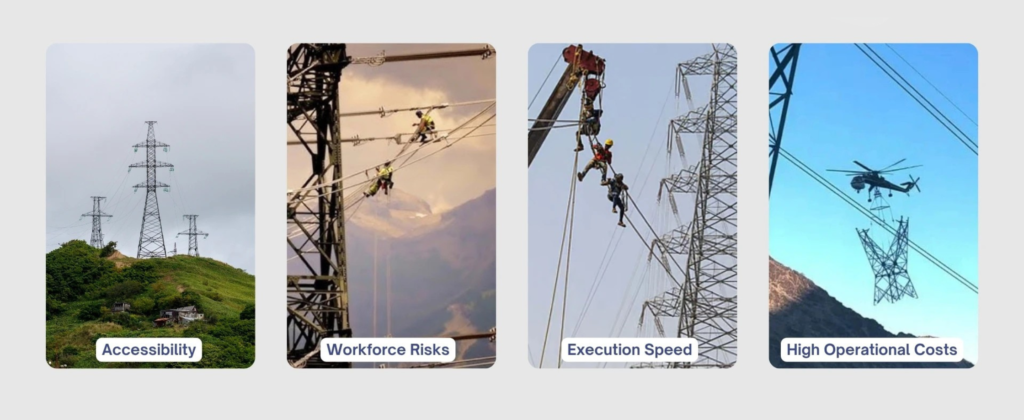
Why Conventional Methods are failing?
Accessibility: -
The most prominent constraint is the accessibility as the Powerlines spread to the difficult terrains, forests, and mountains where even transporting the raw material is a difficult task. In such environment even manpower becomes difficult and time consuming, therefore the modern approach, drone as a service model comes into the picture.
Workforce Risks: -
Conventional Methods are risky for the life of the manpower working in this difficult terrain. Drone led solutions makes the tasks much easy by lifting the heavy materials, stringing the lines and other operations without the human interference.
Execution Speed: -
The traditional methods are very slow in the execution process, Drone based solutions are approximately 85- 90% faster than the human labour. Delays in step of the process can cascade the whole project lifecycle, impacting the cost and delivery commitments.
High Operational Costs: -
Unlike other approaches, the mellow operating costs associated with helicopters, fuel, labour-intensive equipment, and large crews make the performance of the traditional network costly and inefficient. This slow down the process of the execution and hampers the efficiency of it.
Grid Power Operations Applications: Enhancing the Grid Reliability through Drone Based Solutions
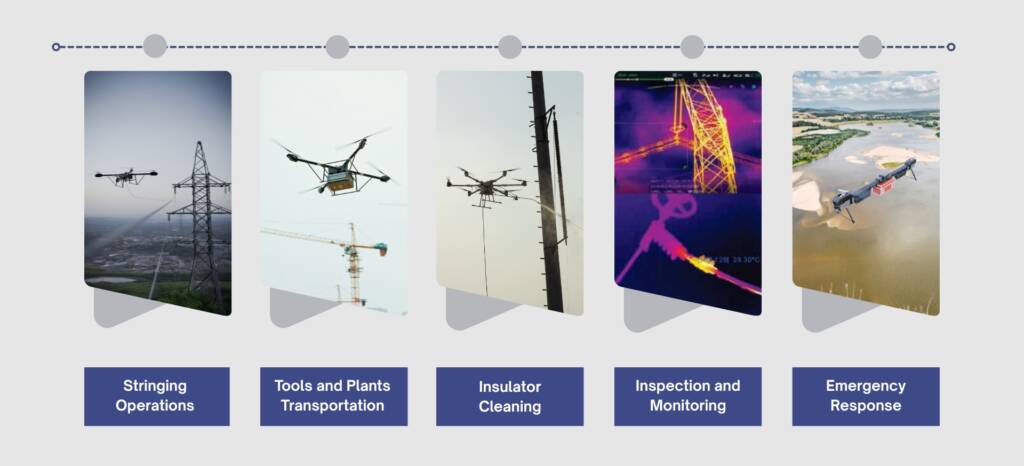
Stringing Operations: -
Unlike other approaches, one of the most decisive applications is the pilot rope and conductor stringing. Looking at this, this traditionally requires a workforce, scaffolding, and, at times, helicopters. As a result, when seeking a better approach, drones enable the use of pilot lines over long distances, thereby concentrating time and risk.
Tools and Plants Transportation: -
Drones can transport tools, nuts, plants and other essential materials directly transported to the tower locations. This technique saves the time, efforts and risk of the accidents of the human labour.
Insulator Cleaning: -
The drone based cleaning systems allow the live line insulation to be maintained, shrinking the need for shutdowns. Basically, this betters the continuity of operation, shrinking workers' exposure to wild environments.
Inspection and Monitoring: -
Something different about this is that inspection of transmission lines is substantive to network protection. In normal words, the monotones allow high resolution visual and thermal inspections of lines, towers, and components, allowing for the detection of defects quickly and efficiently.
Emergency Response: -
During any emergency situations, like outrages and electricity disruptions, drones provide the rapid aerial help and quick solutions to it, reducing the need to shutdowns. This improves the operational efficiency and improves the quality of performing the tasks.
Grid Power Operations Industries: Transforming the Power Sector
The early adopters get the early advantage of seeking the attention of the consumers and this disproportionate advantage benefits the industry’s most, but the question arises that who should adopt it?
Grid Power Mechanism in EPC/ Contractors: -
Drone Powered Grid operations streamline EPC/ Contractors execution by letting faster mapping of corridors, the laying of pilot cables, on difficult terrain, maintaining simplicity and clarity. The exciting is that by reducing trust in manual work, heavy machinery, significantly subdue project time, improving the safety and accuracy of the labour.
Streamlining stringing operations that is lifting and guiding stringing cables safely across long and challenging spans, ensuring faster and risk-free delivery.
Lean & efficient execution by eliminating the need for helicopters, scaffolds, and high-risk manual climbs.
Grid Power Mechanism in O and M: -
In Operations and Maintenance, drone based solutions processes permit high resolution inspection, online clean-up, and rapid detection of errors on transmission networks. Breaking it down, these functions reduce and minimize manual interventions in hazardous environments and endorse proactive maintenance strategies.
Enhanced safety & compliance by minimizing the risks to workers' lives in difficult terrains and ensuring quality standards.
Optimized cost efficiency by reducing project delays by replacing the manpower with drones.
Transforming Grid Power Operations: Why EndureAir Stands Out?
We help societies to achieve faster and safer Powering tasks without a drone being taken into possession, maintaining simplicity and clarity. Through our Drone-as-a-Service (DaaS) model, you get access to proven UAVs, smart software, and a team of experts who make execution simple and reliable. we manage heavy loads, mapping, and planning corridors to cable ranges, maintenance of tugboats with insulator inspections and cleanup, so your teams can focus on network preservation and community connectivity. There are a few reasons that help us to stand out among all.
Speed And Reliability: -
We facilitate quick deployment and timely execution of the project, minimizing the downtime and maximizing the outcome.
Safety And Security: -
Our Drone based solutions ensure the safety and security of the labour by minimizing the human exposure to the high altitudes, eliminating the manual risk.
Cost Effective: -
We Cuts down the need for cranes, porters, and helicopters in stringing and inspection tasks, this reduces your cost and improve your effectiveness
Accessible and Scalability: -
Our drone based solutions are highly accessible and scalable as it reaches the difficult terrains and areas where it's difficult or time taking for humans to reach.
Sustainable and Eco- Friendly: -
We Encourages environmentally low-impact usage with little environmental disturbance.
Automating Grid Power Operations: Upgrading to Smarter Power Sectors
Grid Operations are no longer just an execution function; they are a strategic enabler to upgrade the power infrastructure into a smarter, faster, and more efficient manner. The future of Powerline operations lies in the integration of automation and intelligent software.
They are strategic drivers of power infrastructure development. Their ability to surrender projects faster, maintain assets efficiently, and respond to real-time challenges straightaway affects the reliability and scalability of the energy power sector.
As the industry continues to evolve, organizations using this engineering will be better placed to produce sustainable and renewable electricity and future-ready power networks.